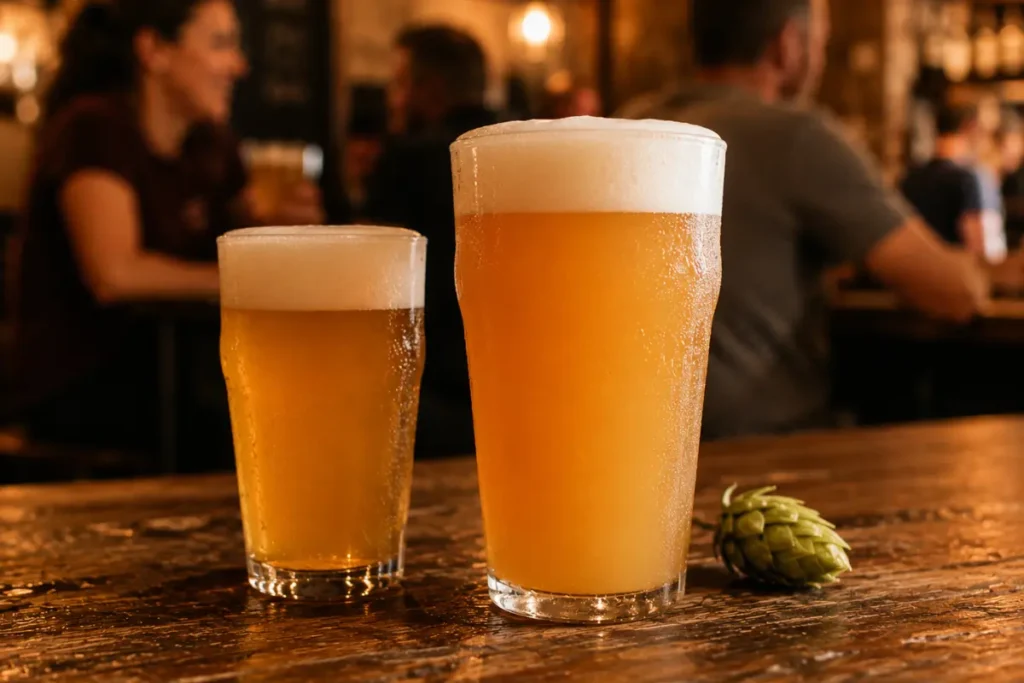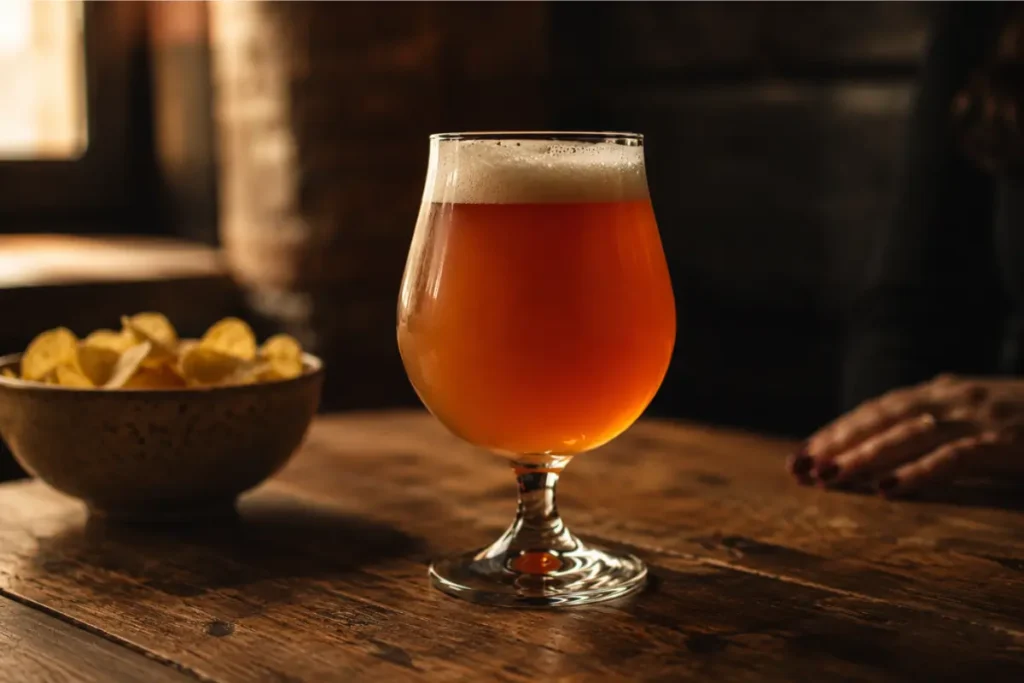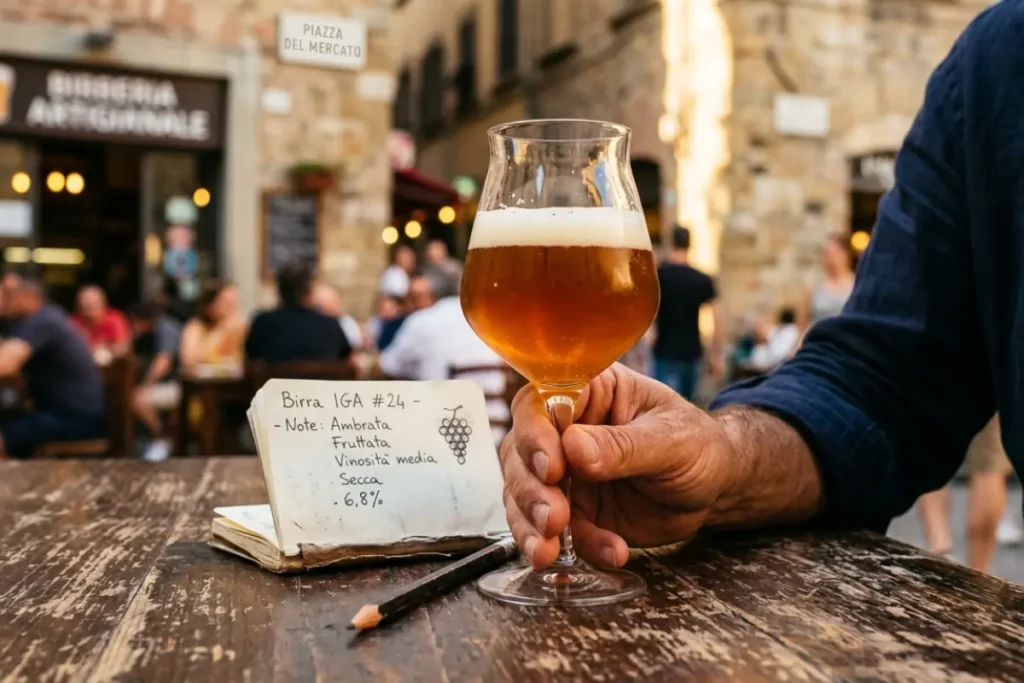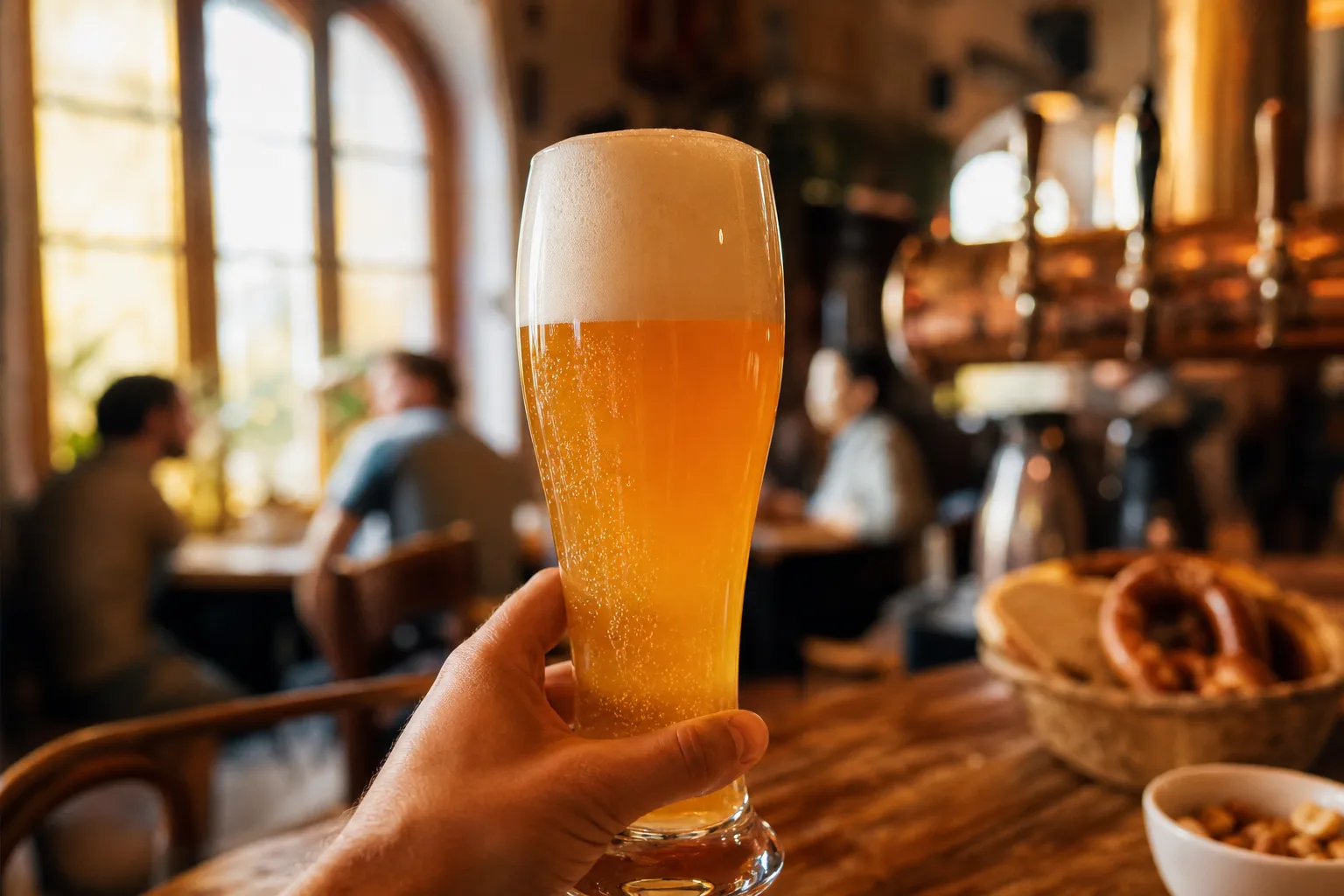
A July evening, a table outside, and a tall glass arriving with a white, puffy head of foam that almost spills over the rim. The colour is golden, nearly opaque, light barely making it through. The first sip brings something unexpected: a soft note of ripe banana, then a spiced hint, like a clove you’ve only just brushed against. If you’ve never had a weizen before, that combination is hard to forget.
So what is a weizen? It’s a Bavarian wheat beer with a strikingly distinctive aroma, banana, clove, fresh bread, that makes it recognisable from the first sip. It’s not as sweet as it looks: with an IBU between 10 and 15 and an ABV between 5 and 6.2%, it’s a style that’s light on bitterness and easy to drink. It’s also lighter than its hazy appearance might suggest. It’s an old style, with centuries of history behind it, and today it’s one of Germany’s most recognisable beers, one that’s increasingly showing up in craft taprooms across Friuli and Veneto too. In this article you’ll find everything you need to understand it: where it comes from, what it tastes like, how to recognise it, how to serve it, and where to find it near you.
Contents
What is a Weizen: origins and character of a Bavarian style
Weizen was born in Bavaria, at the heart of German brewing tradition, with medieval roots around Munich and Lower Bavaria. The style took shape between the 16th and 17th centuries, but it was the Reinheitsgebot of 1516, the Bavarian purity law, that changed everything: the law restricted the use of wheat in beer production, reserving it for other food uses instead. As a result, wheat beer became something exceptional, almost a privilege.
And that’s exactly what it became: a noble privilege. The Degenberg family was granted a special license to brew weizen, and when their line died out, the monopoly passed to the Wittelsbachs, the dukes of Bavaria. For a long time, brewing or selling wheat beer without permission was simply illegal. That’s part of why the style never spread the way others did: it was too valuable to be left to the general public.
From decline to a modern revival
By the late 1700s, weizen’s popularity started to fade, pushed aside by the lagers that were winning over Bavarian tastes. The style nearly disappeared altogether, until in 1872 the Schneider family took over the license and relaunched production with real seriousness and vision. From the postwar years onward, and especially from the 1960s, weizen grew back into one of Germany’s most loved and recognisable styles. Today it’s found its way into Italian craft breweries too, including the ones right here in our corner of the northeast.
Weizen, Weiss, Hefeweizen: same glass, different names
If you’ve looked at a beer menu and gotten lost between Weizen, Weissbier, Weiss, and Hefeweizen, you’re not the only one. The good news is that Weizen, Weissbier, and Weiss are synonyms: they all refer to the same family of Bavarian wheat beers. The name weizenbier, also called Weissbier, comes from two different roots: Weizen means “wheat” and points to the main ingredient, while Weiss or Weissbier means “white beer” and refers to the pale, hazy look of the glass. No difference in style, just linguistic and regional variation.
What makes an unfiltered Weizen? Hefeweizen vs Kristallweizen
Here’s where the difference is real, and visible. Hefeweizen, where “Hefe” is German for yeast, is the unfiltered version: the yeast stays suspended in the beer, making it hazy and rich in aroma. It’s the most common version, and the one with the most complex, expressive profile. Kristallweizen, on the other hand, is filtered, clear as glass, with a cleaner profile and less of that fermentation “character” you get in a Hefeweizen. If you’re after aromatic complexity, you won’t find much of it here.
There are also two less common variants worth knowing. Dunkelweizen is a darker version, with malts that bring amber tones and toastier notes while keeping the wheat base. Weizenbock is the bigger, boozier version of the style, with a fuller body and an ABV that can climb past 7%.
Weizen vs Belgian blanche: two different styles
It’s common to hear someone use “weizen” and “blanche” as if they were the same thing. They’re not. Blanche, or Belgian witbier, uses wheat that’s often unmalted and includes added spices in the recipe: coriander and bitter orange peel are the classic ingredients, and you can taste them clearly in the glass. Bavarian weizen, on the other hand, contains no added spices at all: every aroma you pick up, banana and clove included, comes exclusively from the yeast and the fermentation process. Same wheat base, completely different stories.
If you lean more towards blanche: my picks across Friuli and Veneto
I’m taking over the pen for this part: Paulo isn’t much of a blanche fan, so this section is written in the first person.
We’ve mostly talked about weizen so far, but if the note that wins you over is that citrusy one and you find yourself drawn more to Belgian blanche, here are a few addresses in Friuli and Veneto I’ve tried myself.
àgro, a farm brewery (birrificio agricolo, meaning the brewery grows its own ingredients on-site) in Giais, remains one of my favourites: sharp orange peel aromas, a light, easy-drinking body, fresh with a bitter note at the very end, but a very light one, almost reminiscent of a light Moscato, the sweet Italian wine. I go back just for that one often.
Birra di Meni makes the Dreon, and here the story shifts a little. By Italian standards, it’s an excellent blanche, but the bitter finish comes through more: for me, being Brazilian, it brought back memories of a candied orange peel dessert you find in Minas Gerais, back home. It’s a good beer, but that bitterness stops me from having more than one: not because I don’t like it, but because it’s missing some of the lightness you’d expect from a Belgian blanche. Still, it’s absolutely worth trying.
A few other names I know and happily recommend: the Minela from Bradipongo, the Thymus from La Rü, and the Opalità from Garlatti Costa. I’ve also written about them in our posts on Italian craft beer and craft beer in Udine.
There’s also an offbeat version worth a mention: at Galassia Beer Garden, the outdoor taproom of Birrificio Galassia in Pordenone, I tried the Pink Moon, a hibiscus blanche. Very light, and you can really taste and smell the hibiscus.
What you actually taste in a glass of Weizen
The most common question is always the same: “Did you actually put banana in this?” The answer is no, and that’s one of the most fascinating things about the style. The ripe banana note comes from a compound called isoamyl acetate, an ester naturally produced by the yeast during fermentation. The spiced clove character, meanwhile, comes from 4-vinyl guaiacol, a phenol typical of the yeast strains traditionally used in Bavarian weizen. You don’t need to understand the chemistry, just know that there’s no fruit or spice added, it’s all down to the yeast at work.
The other notes: bread, fruit, and a crisp finish
Alongside banana and clove, a good weizen carries notes of fresh bread, warm grain, sometimes a light citrus touch. The finish is refreshing and slightly dry, with very little bitterness: the IBU, the index that measures a beer’s bitterness, sits around 10 to 15 (out of a theoretical maximum of 100). It’s a style built to be enjoyed without tiring the palate, perfect if you’re just getting into craft beer.
How it looks in the glass: appearance and stats
Visually, an unfiltered weizen is unmistakable. The colour ranges from pale straw to gold, with a hazy veil that makes it almost glow against the light. That haze isn’t a flaw: it’s the suspended yeast, along with the wheat’s proteins, that gives the beer its distinctive character. The foam is white, generous, and surprisingly long-lasting, thanks in part to the high percentage of wheat in the recipe (at least 50%), which brings more protein than traditional malted barley.
On the technical side, a classic weizen sits at these numbers: ABV between 5 and 6.2%, IBU around 10 to 15, colour between 9 and 14 EBC (the European scale that measures beer colour, from lightest to darkest). It’s an easy-drinking beer, light on bitterness, made for food or good company.
How to serve it: glassware and pairings
Weizen has its own dedicated glass, the classic Weizenglas: tall, narrow at the base and flared towards the top, built to hold 500ml with all that foam. The shape isn’t random: it draws out the aroma, supports the foam, and shows off the beer’s hazy look. The ideal serving temperature is between 6 and 8°C: too cold and the banana and clove aromas shut down; too warm and the beer loses its freshness and goes flat. It’s a rule that applies to most styles: the more delicate a beer’s aromas, the colder it should be served, while more structured beers, like a stout or an aged dark beer, open up better at higher temperatures, closer to 12-14°C. Serving temperature is a topic that deserves its own article, and one day we’ll write it.
If you’ve got a Hefeweizen in a bottle, it’s common practice to gently roll the bottle between your palms before pouring, to resuspend the yeast that’s settled at the bottom. Don’t shake it, just roll it slowly. Then pour most of the contents into a tilted glass, and finish by swirling in the cloudy sediment to give the beer its trademark hazy look.
What to pair it with
Weizen is a versatile beer, ideal for summer and for Mediterranean food. It works especially well with:
- fresh, light dishes: salads, grilled vegetables, margherita pizza
- fresh cheeses and dairy: mozzarella, stracchino, robiola
- fish, light fried food, and wheat-based dishes like fresh pasta or gnocchi in butter
- delicate cured meats like prosciutto crudo and bresaola, which won’t overpower the yeast’s aromatic profile
It’s best avoided with fatty red meats, very aged cheeses, or very spicy dishes: the weizen’s delicate aromatic profile would get lost, wasting everything the yeast built up during fermentation.
Craft Weizen in Friuli and Veneto: where to find it
The Bavarian style has a clear reference point here too, and it’s worth knowing about. Birrificio San Gabriel in Levada di Ponte di Piave, in the Treviso countryside, is our go-to for weizen in Veneto. It’s not a name we’re dropping just because we’ve heard of it: we go back specifically for their weizen. Sometimes that’s the whole reason for the trip, other times we stop by because we’re already in the area for something else, but the result is always the same: a glass worth the detour.
We know Zahre Beer from Sauris from a visit a while back: we don’t have a fresh enough memory of their weizen to go into detail here, but it’s a historic name on the Friuli scene and it’s on our list to revisit.
There are a few other names we know produce a weizen and that we still haven’t tried in person: Birrificio Gjulia, Campagnolo, Cittavecchia, Birrificio del Doge, and Birrificio Veneto. We haven’t tasted them yet, but they’re on our list, and we’ll update this article with our impressions as soon as we do.
Common questions about weizen beer
What is a weizen?
Weizen is a Bavarian wheat beer, traditionally brewed with at least 50% wheat in the recipe. It’s known for banana and clove aromas produced by the yeast during fermentation, a generous head of foam, and a hazy appearance in its unfiltered version (Hefeweizen). It’s light on bitterness, easy-drinking (5-6.2% ABV), and very versatile at the table.
Does weizen contain added fruit or spices?
No. The banana and clove aromas come entirely from the yeast during fermentation, with no fruit or spices added. This is exactly where it differs from Belgian blanche, which does include coriander and orange peel in the recipe.
Where can I find a craft weizen in Friuli and Veneto?
Our go-to is Birrificio San Gabriel, where we go back specifically for their weizen. We also know Zahre Beer in Sauris from a past visit. Other breweries in the area, like Gjulia, Campagnolo, Cittavecchia, Birrificio del Doge, and Birrificio Veneto, have a weizen in their lineup and are on our list for future tastings.
The next time you see “Weizen” on a menu
We’re back where we started: the summer afternoon, the hazy glass, the first sip. Now you know what’s actually in it. Centuries of Bavarian history, a yeast that turns wheat into banana and clove without adding a thing, a style built to be drunk slowly and with a smile. You can tell a Hefeweizen from a Kristallweizen, a Bavarian weizen from a Belgian blanche, and you know where to find a good one without travelling too far.
So, what is a weizen, really? It’s much more than a hazy beer: it’s a style with a precise history, a fascinating bit of chemistry, and a rightful place in northeastern Italy’s craft beer scene. The next time you see “Weizen” or “Hefeweizen” written on a chalkboard or a menu, you’ll already know what to expect. Order it. And if you’ve found a good spot in Friuli or Veneto pouring one well, let us know: email us at hello@beersandtips.it, we’re always curious to discover new taprooms and new glasses worth the trip.
Before you go, the takeaways:
- Weizen is Bavarian, blanche is Belgian: same wheat base, but only blanche uses added spices
- Banana and clove come entirely from the yeast, not from fruit or spices in the recipe
- Serve it cold but not ice-cold, between 6 and 8°C, in its tall glass so you don’t lose the aromas
- In Friuli and Veneto, our go-to for weizen is Birrificio San Gabriel
- If you’re drawn more to blanche’s citrusy note, àgro and Birra di Meni are two stops worth making