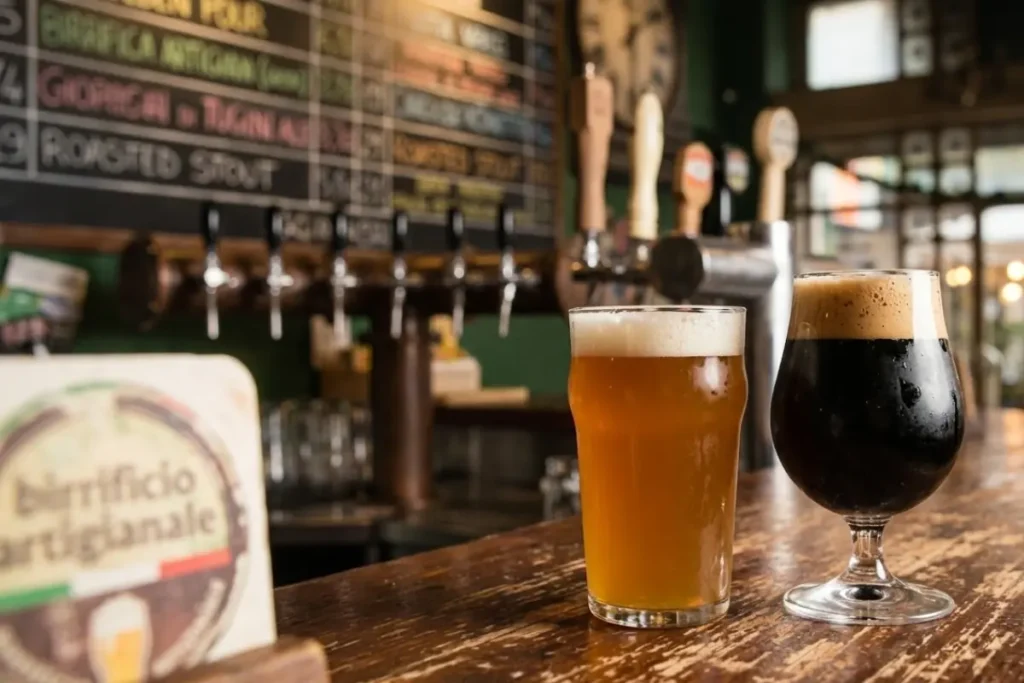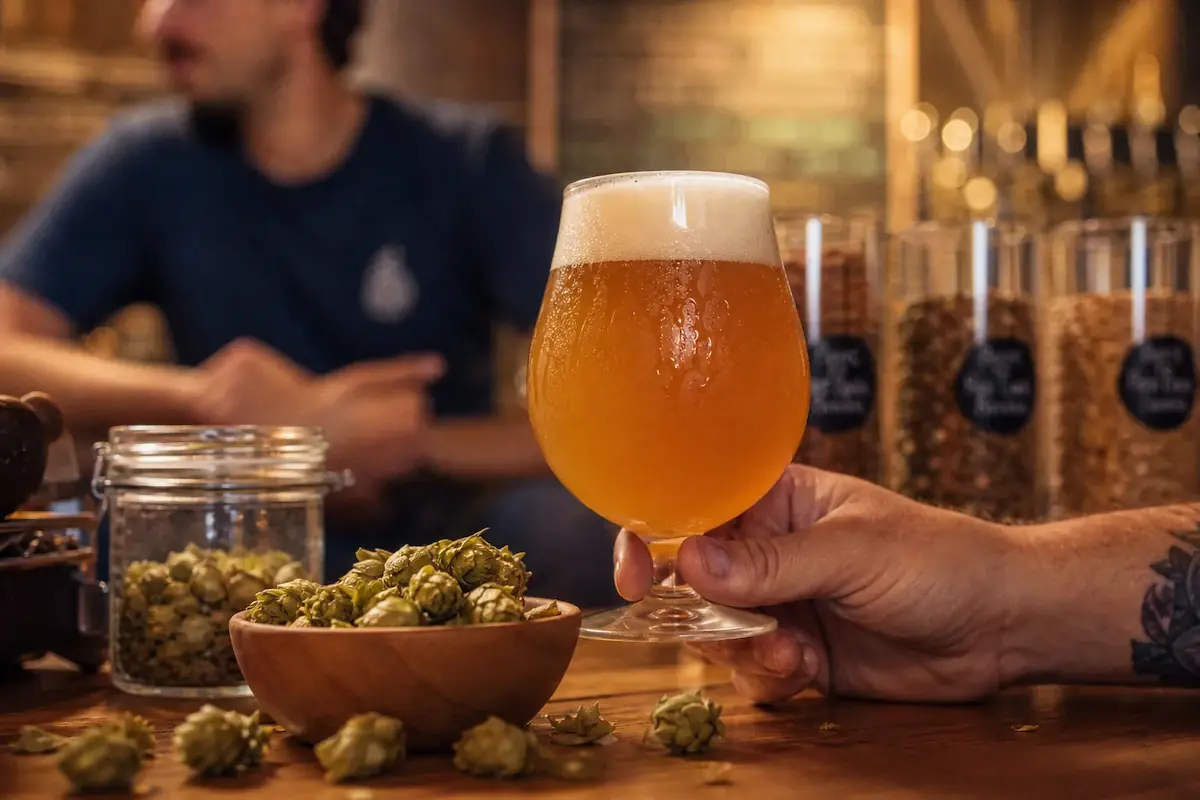
You’re opening an IPA from a brewery in Friuli, up in Italy’s northeast corner. Before you even take a sip, you bring the glass to your nose: grapefruit, a touch of resin, maybe passion fruit. Then you try a craft lager from Veneto and get something completely different, herbal, fine, almost floral. Where do those aromas come from? The answer is always the same: hops.
Hops are the most talked-about ingredient in craft beer, and also the most misunderstood. When we write about beers from Friuli and Veneto, we often mention citrus notes or a resinous aroma: behind them there’s always a specific hop variety. Understanding hops in craft beer means understanding what’s actually in your glass. This guide walks you through the main varieties, how they work and how to recognize them, no chemistry books required.
Contents
What hops do in beer, beyond bitterness
Most people associate hops with bitterness and stop there. In reality, hops do two distinct things: they build the bitter backbone and they define the aroma profile. Understanding this difference changes the way you taste a beer.
Alpha acids: where the bitterness comes from
Alpha acids, often listed as “AA%” on technical sheets, are the compounds responsible for bitterness. The higher they are, the more bitter the finished beer can be. That bitterness is measured in IBU (International Bitterness Units): a pils usually sits between 20 and 30 IBU, a West Coast IPA can reach 60 to 80, and you feel the difference from the very first sip.
Aromatic oils: the delicate, more interesting part
Aromatic oils are the volatile compounds that give beer its perfume: tropical fruit, citrus, grass, resin, flowers. The problem is that they are extremely fragile and vanish with heat. That’s why the moment hops are added during the brew changes the result in your glass completely.
Bitterness or aroma: it all depends on when you add them
The same hop variety can give opposite results depending on when it enters the process. Brewers know this inside out, but it’s a mechanism you can grasp as a simple drinker too.
Early in the boil: bitterness yes, aroma almost zero
Hops added in the first 60 to 90 minutes of the boil release almost all their bitterness and lose almost all their aroma, which escapes with the steam. Their job is to balance the sweetness of the malt and give the beer structure. These are bittering hops, usually high in alpha acids, and you almost never smell them.
Late in the boil and after fermentation: aroma is born
Hops added at the end of the boil, or in the whirlpool (when the wort is swirled at lower temperatures, where hops release aroma without adding much bitterness), keep their aromatic oils. Dry hopping goes further: hops are added directly into the fermenter, cold, after fermentation. The result is an explosion of fresh, tropical or resinous aromas, without a single extra gram of bitterness. Many modern Italian craft IPAs owe their entire aromatic punch to this technique.
The varieties you’ll meet most often in your glass
There is no such thing as “the” hop: there are dozens, each with a very distinct character. Some smell of wildflowers, others of pink grapefruit, others of passion fruit or wood. Here are the main families you’ll find in Italian craft beers.
The European classics: tradition and finesse
These hops are the signature of traditional European beers. You recognize them by their quiet elegance, never intrusive. A great starting point for training your nose.
Saaz (Czech Republic): spicy, herbal, with notes of hay and white pepper. This is the hop of Bohemian pils, the one behind that clean, orderly finesse.
Hallertau Mittelfrüh (Germany): floral, soft, with a light citrusy freshness. The signature of German Helles, more delicate than Saaz but just as noble.
East Kent Golding (UK): earthy, sweet, with an almost honey-like note. Perfect in classic British ales.
Fuggle (UK): rustic, woody, with hints of tobacco and earth. You often find it in stouts and porters, where it helps build that dark roundness they’re known for.
The newcomers: America and the southern hemisphere
These hops have been revolutionizing craft beer since the nineties. They are intense, recognizable, often divisive. Many Italian IPAs use them as the main aromatic base, both for how they perform in dry hopping and for the intensity of their tropical and citrus notes.
Cascade (USA): the founder of the modern citrus family. Pink grapefruit, orange zest, wildflowers. The hop that changed everything.
Citra (USA): intense, almost explosive. Citrus, passion fruit, lime. Small amounts are enough to fill the glass with aroma.
Mosaic (USA): a kaleidoscope of berries, balsamic herbs and pine. More complex and layered than Citra.
Simcoe (USA): pine, resin and grapefruit, with an earthy, almost wild undertone. Born in 2000 in Washington State, it’s one of the favorite hops for dry hopping American IPAs, and now you know why you see it mentioned so often.
Galaxy (Australia): passion fruit, peach, exotic citrus. A profile close to Citra, but with an even more defined aromatic cleanness.
Nelson Sauvin (New Zealand): winey, almost Sauvignon Blanc-like, with a note of white pepper. Instantly recognizable, unique in the world.
How hops in craft beer express themselves, from Friuli to Veneto
Reading aroma profiles is one thing, recognizing them in a real beer is another. Connecting varieties to styles, with concrete examples, is the fastest way to train your palate.
IPA and Double IPA: when hops take the lead
Modern Italian IPAs often use American hops like Citra, Mosaic or Simcoe in dry hopping. The profile is direct, almost always intense, and the hops leave no room for interpretation. Several breweries in Friuli and Veneto that we’ve tasted in person build beers where the tropical and citrus aromas are recognizable the moment the bottle opens. If you smell grapefruit and passion fruit in an Italian IPA, there’s often Citra or Galaxy in the fermenter.
Pale Ale and craft lager: balance and subtlety
In Pale Ales and craft lagers, hops work in a more restrained way. An APA with Cascade gives a lovely citrus lift without covering the malt. Saaz in a Friulian pils delivers that herbal, spicy finesse that clearly separates craft from industrial. Hallertau Mittelfrüh in a Veneto Helles brings floral notes and softness. Quieter beers, but for that very reason an excellent training ground for learning to recognize varieties.
Hops grow here too: three producers in Friuli
So far we’ve talked about hops that travel from Germany, the United States, Australia. But here’s something that fills us with pride: hops grow right here in Friuli too, and in a couple of cases practically on our doorstep.
Let’s start with the farthest one, though still in the region: in Taiedo di Chions, in the province of Pordenone, Birrificio Agricolo Zago (a farm brewery, meaning it grows its own ingredients) cultivates barley and hops in its own fields and uses them for its beers. We’ve tasted them: honest beers, rooted in the territory, the kind you’re glad to come across.
Then there are the two producers closest to our hearts, both between Polcenigo and Budoia. A heads-up: they are two separate projects, even if they’re neighbors with the same idea at their core.
The first is Luppolo Verde in Polcenigo. Behind it is Federico Comel, a former Italian bobsleigh champion who left the sled to return to his grandfather’s land and start growing organic hops, beginning in 2017. He has since opened a birreria (a beer-focused pub) in Budoia, on via Pordenone, where you can taste his beers and see for yourself what hops made in Friuli means. We’ve written about them before here.
The second is Sant’Osvaldo Beer, also in Polcenigo, which grows Comet hops in its own fields. It doesn’t brew in-house: it partners with a craft brewery to produce its farmhouse beers, all named after virtues, from Temperanza (Temperance, an IPA) to Prudenza (Prudence, an American Pale Ale). These are people we know personally: every year, during the Sagra dei Thést, Polcenigo’s traditional village festival, they open their shop and line up all their beers. We’ve tried them one by one, and we didn’t find a single one that let us down.
Three ultra-short supply chains, three different ways of saying the same thing: good hops don’t have to come from far away.
Dosages, substitutions and where to buy hops
This part is for anyone getting into homebrewing, meaning making beer at home, or for anyone who just wants to understand what’s inside a recipe. You don’t need to be a professional brewer to find it useful.
How much hops to use: rough amounts by style
Dosages vary a lot by style. For an IPA, you’d use between 4 and 6 grams per litre in the final minutes of the boil, plus another 6 to 8 g/L in dry hopping: for 20 litres (about 5 gallons) of finished beer, you easily end up at 200 grams of hops or more in total. A Pale Ale asks for less, between 3 and 4 g/L in the boil and 3 to 5 g/L in dry hopping. A traditional pils gets by with 1 or 2 g/L, often just for the final aroma. The hoppier the beer, the fresher the hops need to be: for IPAs especially, freshness is everything.
Cones or pellets: which format to choose
Hops come mainly in two formats: cones (the whole dried flowers) and pellets (ground and pressed into small cylinders). Cones preserve the original structure of the aromatic oils better and some brewers prefer them for small-scale brews, but they don’t last as long and take up more space. Pellets are the most practical and stable format for home use: they’re compact, keep longer and distribute more evenly in the brew. For most homebrewers in Italy, pellets remain the most convenient and reliable choice.
What to do when a variety is out of stock
Citra nowhere to be found? Mosaic sold out? It happens, and it’s no tragedy. The substitution principle is simple: replace a hop with one that has a similar aroma profile, not necessarily the same origin. Citra and Galaxy swap well in many recipes for a similar tropical profile, with different nuances. Cascade and Amarillo work in each other’s place in Pale Ales. Saaz and Hallertau trade places in traditional European lagers. They won’t be identical, but the result will stay true to the style.
Where to buy hops in Italy and how to store them
Two of the main Italian homebrew suppliers are Beer & Wine in Fidenza, near Parma, and Mr. Malt in Pasian di Prato, near Udine, right here in our Friuli. Both carry wide catalogs with European, American and Australian varieties in pellet form. To store them properly: vacuum-sealed bag, darkness, freezer. Oxidized hops lose their aromatic oils irreversibly, and in an IPA you notice it immediately.
Train your nose, one glass at a time
Next time you open an IPA from Friuli or Veneto, smell it before you drink. That cloud of grapefruit, passion fruit or fresh grass has a precise name, and now you know where it comes from. This isn’t sommelier territory: it’s simply knowing what you’re drinking, and that makes every sip more interesting.
Common questions about hops in craft beer
What do hops do in beer?
Hops do two things: they provide bitterness, thanks to alpha acids, and aroma, thanks to aromatic oils. They balance the sweetness of the malt and, depending on the variety, bring notes of citrus, tropical fruit, grass, resin or flowers. Hops define a large part of a beer’s character.
What is dry hopping?
Dry hopping means adding hops directly into the fermenter, cold, after fermentation. It extracts only aroma, with no added bitterness. It’s the technique behind the explosion of tropical and citrus aromas in modern IPAs, and one of the reasons these beers smell so intense the moment you open them.
Do hops grow in Friuli?
Yes. Several producers grow hops in Friuli: Birrificio Agricolo Zago in Taiedo di Chions, Luppolo Verde in Polcenigo (Federico Comel’s farm, with a birreria in Budoia) and Sant’Osvaldo Beer, also in Polcenigo, which grows Comet hops. Short supply chains that unite hop growing and beer on local ground.
Now that you know the main hops in Italian craft beer, the rest is practice. On our blog you’ll find the stories of the Friuli and Veneto breweries we’ve visited and the beers we’ve tasted, aroma profiles included: read them with a glass in hand. And if you recognize one of the hops we’ve covered here in a beer, let us know at hello@beersandtips.it.
Before you go, the takeaways:
- Hops do two different jobs: bitterness from alpha acids, aroma from aromatic oils
- Timing is everything: early in the boil for bitterness, late or in dry hopping for aroma
- European hops (Saaz, Hallertau) bring quiet finesse; American and southern hemisphere ones (Citra, Mosaic, Simcoe, Galaxy) bring tropical and citrus intensity
- Hops grow in Friuli too: Zago in Taiedo di Chions, Luppolo Verde and Sant’Osvaldo Beer in Polcenigo
- You don’t need books to recognize them: smell before you drink, one glass at a time