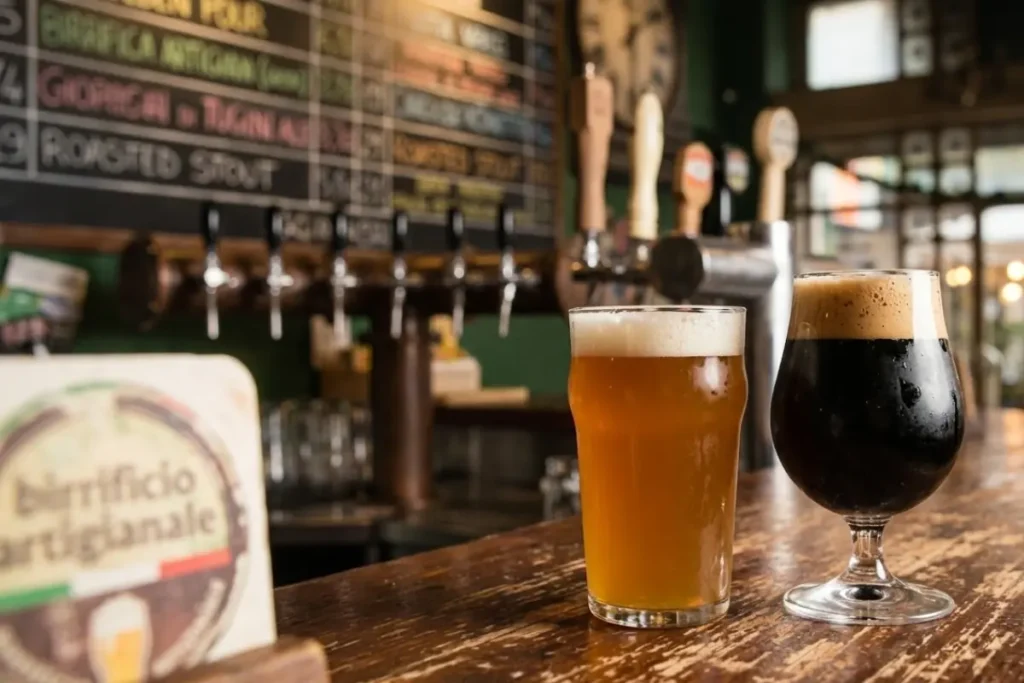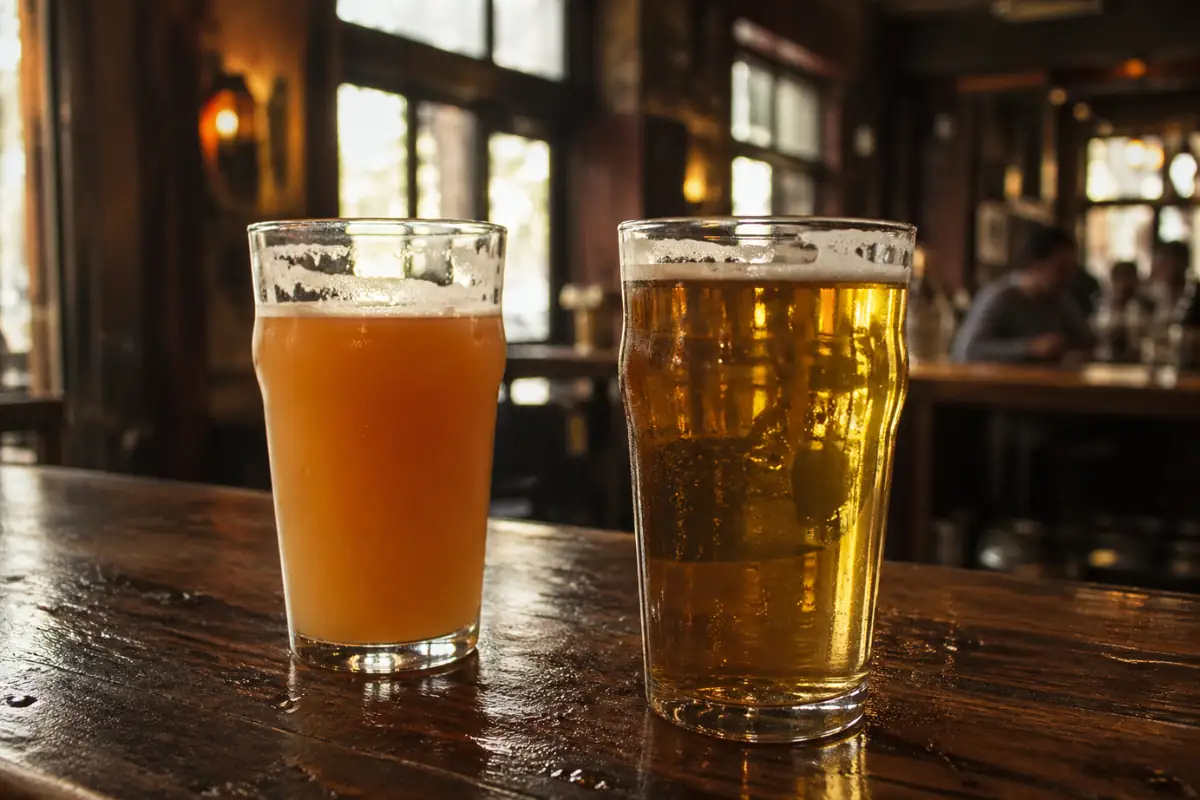
You’re sitting at a small table. Two beers in front of you: same pint glass, same golden color. But from the very first sip, you know they’re not the same thing. Why?
We’ve heard that question more times than we can count, every time someone tasted a craft beer for the first time and looked up with that slightly puzzled expression: why does it taste so different? The answer comes down to four concrete things: the ingredients, how the beer is made, how “alive” it is in your glass, and the values behind every sip. Let’s go through them one by one.
Contents
Craft beer vs industrial beer: it starts with the ingredients
Beer, in its purest form, is made of four things: malted barley, hops, water, and yeast. Four ingredients. That’s it, when used well. But inside those four ingredients, there’s an entire world.
Malted barley is the soul of beer. It gives body, sweetness, and color. A lightly toasted malt produces a pale, lighter beer. One that’s been roasted much longer, almost to the point of burning, brings flavors of coffee and dark chocolate: that’s what turns a beer into a rich, full-bodied stout. Craft breweries choose their malt the way a good cook chooses flour, with intention. Some go even further: they grow their own barley in the field, closing the loop between land and glass. A rare choice, but one that says more than a thousand words about what it really means to make craft beer.
Hops are the spice of beer. Added during the boil, they bring bitterness. Added later, at lower temperatures, in a process called dry hopping, they release intense aromas of fruit, resin, flowers, or citrus without adding extra bitterness. That’s why some craft beers smell of grapefruit or pine even before you take a sip.
Yeast is probably the most underestimated ingredient. You can’t see it, but you can absolutely taste it. It’s yeast that, by consuming the malt’s sugars, produces alcohol and, more importantly, aroma. A Belgian yeast brings fruity, spicy notes. An English one leans toward caramel and biscuit. An American strain stays neutral, letting the hops shine. Craft breweries guard their yeast strains like family recipe secrets.
And then there’s water, which sounds boring until you realise how much it matters. Its mineral composition can shift the final flavor in ways that genuinely surprise people. It’s not a coincidence that certain cities became famous for certain beer styles: Pilsen in the Czech Republic built its reputation on exceptionally soft water, while Burton-on-Trent in England owed its legendary ales to a supply rich in minerals. Craft breweries in Friuli and Veneto today treat their water with the same care and intention as everything else that goes into the tank.
In industrial production, malted barley is often partly replaced by cheaper grains like corn and rice. That’s not deception: it’s an efficiency choice, to lower costs and standardize the product at scale. On top of that come stabilizers, sulfites, citric acid, and in some cases artificial flavorings, all extending shelf life and keeping the taste consistent from one batch to the next.
The result is a beer that’s predictable, always the same. A craft brewery, instead, chooses selected malts, fresh hops (often Italian), and carefully cultivated active yeasts. That choice shows up in your glass: more complex aromas, a flavor profile that shifts as you drink, something that’s actually worth paying attention to.
How it’s made: fermentation, pasteurization, and filtration in plain terms
The craft beer production process begins with milling the malt, which is then mixed with hot water in a step called mashing. During this phase, enzymes in the malt convert starches into fermentable sugars: this is the moment the beer starts taking shape. The liquid produced, called wort, is separated from the grains, brought to a boil, and that’s when the hops go in.
Yeast is what transforms those sugars into alcohol and flavor. In craft beers, fermentation happens at higher temperatures, roughly 16 to 26°C (60 to 80°F), and takes longer. This gives the yeast more room to work, developing complex aromas and real character. It’s not just chemistry. It’s time. And in a craft brewery, time is as much an ingredient as anything else.
Industrial beers use low-temperature fermentation: fast, automated, designed to produce large volumes quickly. The result is efficient, but it leaves little room for complexity.
After fermentation comes conditioning: the beer rests, the flavors settle and come together. In craft breweries, this can take weeks, sometimes months for certain styles. Some beers are even aged in wooden barrels, which contribute notes of vanilla, caramel, or spice. Every barrel tells a different story.
Pasteurization and microfiltration: what gets lost
Then comes pasteurization. In simple terms: the beer is heated to eliminate microorganisms and ensure a long shelf life. It works, but heat flattens the aromas, making the beer more neutral, stable, and less alive. Microfiltration works similarly: very fine membranes make industrial beer clear and bright, but remove precious aromatic compounds in the process.
Worth saying: not every industrial beer is pasteurized. Some larger brands have started offering unfiltered or unpasteurized versions, a sign that something is shifting even in mass production. But these are exceptions, not the rule.
Craft beer, under Italian law (Law n. 154/2016), cannot be pasteurized or microfiltered. This keeps it fresh, authentic, and full of nuance. It’s often hazy, and that haziness is not a flaw. It can come from proteins, active yeasts, or grain sediment. Not every craft beer is hazy, but when it is, that visual texture is usually a sign of a genuine production process.
Freshness and shelf life: the “living” beer vs the one that lasts for years
An unpasteurized, unfiltered beer is essentially a living product. If it contains active yeast, as is the case with bottle-conditioned beers (beers that undergo a second fermentation inside the bottle), the aromas continue to evolve over time. It’s a bit like handmade bread: wonderful the day after baking, noticeably different a week later.
That’s why craft beers have a shorter shelf life and need to be kept cold. Industrial beers, thanks to pasteurization and additives, can handle difficult storage conditions for months, sometimes years. It’s not about which one lasts longer. It’s about what arrives intact in your glass.
If you want to know whether you’re buying a genuine craft beer, read the label. Look for the words “non pastorizzata” (unpasteurized), “rifermentata in bottiglia” (bottle-conditioned), or the name of a small independent brewery. Italian Law n. 154/2016 is clear: to be called craft, a beer must come from an independent brewery producing fewer than 200,000 hectoliters per year, with no pasteurization or microfiltration. If the brand belongs to a multinational, it’s not craft, even if the packaging uses words like “crafted” or “selected.”
Craft Beer vs industrial beer: a question of value, not just price
There’s a common misunderstanding about craft beer: that it always costs more. In reality, it depends a lot on where you’re drinking it. In a pub or taproom, the pint price is often similar, craft or industrial. You feel the difference in your glass, not in your wallet.
At the supermarket, the gap is real. An industrial beer generally runs under €2.50 for a 33cl bottle, while a quality craft beer starts at €3 to €5 for the same size. That’s because a small brewery doesn’t have the economies of scale of a large producer: it uses premium ingredients, produces in small batches, and has skilled people overseeing every brew.
You’re not paying for marketing. You’re paying for the actual difference between industrial and craft production. It’s the same logic as buying bread from a local bakery versus a sliced loaf from the supermarket: it costs a little more, but you know exactly what’s in it and why.
Where to start: Friuli and Veneto as your entry point
If you want to understand firsthand what sets craft beer apart from industrial, the most direct way is to taste both side by side. And for that, Northeast Italy is one of the most interesting places to explore. Friuli Venezia Giulia and Veneto have a lively craft scene, deeply rooted in the region and still growing fast. Places like LZO in the Treviso area, Agribirrificio Borgo Decimo in Friuli (where the barley is grown on-site), or Wild Raccoon in Udine each represent a different approach to craft beer, with their own philosophy and a taproom open to visitors. And these are just three examples: there are many others, and we’ll be covering them one by one.
You don’t need to be an expert. Just sit down, order, and pay attention. On Beers & Tips, you’ll find guides to breweries in Friuli and Veneto worth visiting, stories about the people behind the beer, and tips on local craft events and festivals, all coming soon.
Common questions about craft vs industrial beer
What’s the real difference between craft and industrial beer?
It comes down to four concrete things: the ingredients used, the production process, how “alive” the beer stays in the glass, and the value behind every sip. Craft beer uses selected malts, fresh hops, and carefully cultivated yeast, isn’t pasteurized or microfiltered, and under Italian law (Law n. 154/2016) must come from an independent brewery producing under 200,000 hectoliters a year.
How can I tell if a beer is genuinely craft?
Check the label. Look for “non pastorizzata” (unpasteurized) or “rifermentata in bottiglia” (bottle-conditioned), and make sure the brewery is actually independent: if the brand belongs to a multinational, it isn’t craft, even if the packaging uses words like “crafted” or “selected.” Haziness, when present, is often another sign of a genuine production process.
Does craft beer always cost more than industrial beer?
In a pub or taproom, often not: the pint is priced similarly whether it’s craft or industrial, and the difference shows up in the glass, not your wallet. At the supermarket the gap is real: an industrial beer runs under €2.50 for 33cl, while a quality craft beer starts at €3 to €5 for the same size. That price difference reflects premium ingredients and small-batch production, not marketing.
What stays in your glass
The difference between craft and industrial beer isn’t hiding in some technical detail you need a brewing degree to understand. It comes down to four honest choices: the ingredients someone decided to use, the time they were willing to give the process, the freshness they chose to protect, and the reason they started brewing in the first place.
That’s not snobbery. It’s just good beer, made with intention.
Next time someone sets an unfamiliar pint in front of you, take a moment before you drink. Look at it, smell it, then taste it slowly. You might be surprised at how much it has to say.
Cheers!
Before you go, the takeaways:
- The real difference between craft and industrial beer: ingredients, process, freshness
- Why a craft beer is “alive” and what that actually means for what you’re drinking
- A question of value, not just price
- Where to start: Friuli and Veneto as your entry point into Italian craft beer